
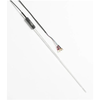
Fluke Calibration has four quartz-sheath SPRTs covering the ITS-90 range of –200 °C to 1070 °C. The 5681 is used from –200 °C to the aluminum point at 660.323 °C. The 5683 is used from –200 °C to 480 °C with greater long term stability. The 5684 covers higher temperatures up to 1070 °C and can be calibrated at the silver point.
Yes, they have all the features you would expect in a world-class SPRT. They have gold-plated spade lugs, a strain-relieved connection to the four-wire cable, convection prevention disks, the finest quartz glass available, delustered stems, and the purest platinum wire available.
The purity of a thermometer’s platinum wire is critical to meeting ITS-90 requirements. Maintaining that purity over the life of the thermometer impacts long-term stability. The quartz glass tube of the SPRT should be properly sealed to prevent contamination of the platinum sensor. Others use mechanical assemblies and epoxy seals. These introduce additional materials to the thermometer’s internal environment and can be prone to mechanical failure, risking exposure of the platinum to impurities.
Theoretically, the best seal would be a direct seal between the quartz glass and the platinum wire. However, the quartz glass used in thermometer sheaths has a very small coefficient of expansion while platinum has a much larger coefficient of expansion. If you simply sealed the sheath’s glass to the platinum wire, these different rates of expansion would result in a poor seal as the assembly is exposed to changing temperatures.
We’ve figured out a way to match the expansion coefficients of the glass sheath and the platinum wires. We do it by creating a graduating seal that’s made of 18 separate pieces of glass, each with a different coefficient of expansion. The expansion and contraction rate of the final piece of glass matches that of the platinum, resulting in an overall seal that prevents gas leakage and impurity penetration for at least 20 years.
Fusing each piece of glass to the next is a painstaking process. Sure it costs us extra! But the results are worth it.
There’s more! We use only pure quartz glass materials for the cross frames, disks, and tubes. We don’t use mica or ceramic materials. We have a special glass-treating process to increase the resistance of the quartz to devitrification and remove more impurities than the typical cleaning process.
We’ve done some research to find the best-performing balance of argon to oxygen in the tube. Some oxygen in the sheath is necessary to minimize the danger of the platinum being poisoned by foreign metals at high temperatures, but too much oxygen at temperatures below 500 °C accelerates the oxidation process affecting the integrity of the platinum. We’ve got a balance that provides exactly the right protection for the platinum.
Each of these seemingly small things adds up to better uncertainties and less drift. Fluke Calibration's SPRTs typically drift less than 0.001 °C per year.
5681: –200 °C to 670 °C
This 25-ohm thermometer is the workhorse of the ITS-90 ranges. It can be calibrated for any of the subranges from the triple point of argon to the freezing point of aluminum. The 5681 meets the ITS-90 requirements for resistance ratios as follows:
W(302.9146 K) ≥ 1.11807
and
W(234.3156 K) ≤ 0.844235
5684: 0 °C to 1070 °C
ITS-90 extended the use of the platinum thermometer from 630 °C to 962 °C. The 0.25-ohm HTPRT sensor uses a strip-shaped support made from high-purity quartz glass. The 2.5-ohm model uses a quartz glass cross frame. Stability after thermal cycling is excellent, and the design is reasonably tolerant of vibration. Choose from 0.25-ohm or 2.5-ohm nominal RTPW values. In addition to meeting the resistance ratio requirements shown above, these thermometers meet the following additional criterion:
W(1234.93 K) ≥ 4.2844
Request a Calibration Quote
We’re here to make calibration easy. Request a quote today and let our team give you the care, precision, and service you can trust.
Learn moreBrowse By Brands
Uncover the brands that set the standard for quality and dependability in every industry we serve.
Learn more