
2900 Automated Humidity Generation System
Self contained system capable of producing atmospheres of known humidities using NIST proven, two-pressure principle, 0.5% of reading RH uncertainty, multi-point touch LCD
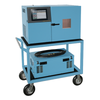
The Model 2900 Humidity Generation System is a self-contained system capable of producing atmospheres of known humidity using the fundamental “two-pressure” principle. This system is capable of continuously supplying relative humidity, dew point, frost point, parts per million, or other calculated values for instrument calibration and evaluation as well as for precision environmental testing. This system will automatically generate manually entered humidity and temperature set points as well as user created multipoint profiles. All desired humidity’s, temperatures, flow rates, and time intervals may be programmed.
• Traceable to SI
• 0.5% of Reading RH Uncertainty
• High Flow Capability of 50 L/min
• Based on NIST Proven "Two-Pressure" Principle
• HumiCalc® with Uncertainty Mathematical Engine
• ControLog® Embedded Automation Software
• Generate: RH, DP, FP, PPM, Multipoint Profiles
• Externally Driven Chamber Fan
• Multi-point Touch LCD
• Fluid Jacketed Chamber Door
• Window Chamber Door (Option)
Humidity Sensors and Chart Recorders: Insert humidity probes through a test port in the chamber or install the sensing systems into the chamber to: determine humidity calibration accuracy and/or characterize humidity sensitivity by subjecting the humidity sensor to a variety of humidity levels; perform operational checks such as the sensing systems capability to correctly calculate and display other humidity parameters; determine the repeatability, stability, hysteresis, and drift characteristics of various humidity sensing systems.
Chilled Mirror Hygrometers: Install the actual chilled mirror head into the chamber or insert a sample tube through the test port and draw a sample through the chilled mirror head to: verify mirror temperature measurement calibration when the hygrometer is in thermal equilibrium with its environment; perform operational checks of the heat pump and optical components before and after mirror cleaning and balancing; determine whether the hygrometer is controlling the mirror deposit in the liquid phase or ice phase when operating at dew and frost points below 0 °C; determine if the hygrometer is correctly calculating other humidity parameters; determine hygrometer’s repeatability, stability, and drift characteristics.
Humidity Sensors And Chart Recorders: Insert your humidity probes through a test port in the chamber or install the hygrothermograph into the chamber and you can: determine humidity calibration accuracy and/or characterize humidity sensitivity by subjecting the humidity sensor to a variety of humidity levels; perform operational checks such as the sensing systems capability to correctly calculate and display other humidity parameters; determine the repeatability, stability, hysteresis, and drift characteristics of various humidity sensing systems.
Environmental Testing: The 2900 can serve as a test bed for evaluation and R&D of humidity sensors, humidity sensing systems, and humidity sensitive products, e.g., polymers, composites, film, magnetic medium, pharmaceuticals, soil hydrology, consumables, electronics, optics, etc.
 Thunder Scientific
WDA Window Chamber Door Assembly
Window chamber door assembly for model 2900
Call Today!
800-567-8686Normally ships in 6-8 weeks